Showing posts with label 1st grade. Show all posts

Monday, April 1, 2019

Keepin' it Easy: Thumbprint Pussywillows!

I was out for a walk today by a local pond and wetland area, and discovered some pussywillows growing, which, at least around here, are the predecessor of all other spring growth.  They are a favorite of mine, and made me recall a favorite one-class art project that I did annually with my kindergartners until I retired.

I think it is important to remember that a good art project doesn't have to be complex and take a long time to do to be worth doing.  There's a lot of value in the simplicity of this project.
  
Each year, I'd bring a batch of pussywillows in to the art room.  I would give my kindergartners time to touch them, feel their softness, and stroke their cheeks with them.  Then we'd look at the shapes of the branches, and how the little soft pussywillows grow along the stems.  The kids would also observe the dark little seed pods at the base of each fuzzy bud.

We looked at various vases I had placed on the tables, and how they were shaped.  Students each chose a sheet of colored construction paper (I usually offered a menu of various springtime colors), and began by choosing a shape for their vase, and drawing it using crayons.  Crayons were also used to add the stems and the little dark seed pods. Each table also had some real pussywillows on it, so the kids could use them for reference as they drew their stems.
Then I lightly mixed a blend of white paint with some silver and a touch of black, that I placed in a shallow dish on each table.  The kindergartners used their thumbs as stampers to stamp pussywillow buds on top of the seed pods.  And that's it!  Cleanup is as easy as a wipe of the thumb with a baby wipe!  Easy-peasy observational project that can be completed in one class period!   

 I did a similar annual one-class project with my first graders, when the lilac tree in my backyard bloomed each year.  Again, we looked at the flowers (and of course we sniffed them, too!).  We noted how they grow in clumps, and we looked at the shape of the lilac leaves.   We drew vases, this time including a table surface, and again we drew stems, adding leaves as well.  I mixed a selection of lilac colors, using varying amounts of white, purple, magenta, and blue, and the students used cotton swabs to paint their flowers.  Disposable paintbrushes = easy cleanup!  For more info, and much better  photos than those below, check out this post from June 2016.

Sunday, November 26, 2017

Sculpture from scrap cardboard!

Just before Thanksgiving, I returned from my NY state art teachers annual convention, a whirlwind weekend of learning, creating, presenting, engaging, and more.  While there, I presented two workshops; I'm going to tell you about one of them in this post, and I'll tell you more about the convention and the other workshop in another post.  The workshop I'm telling you about today was called From Scraps to 3-D Success, and I co-presented with a friend (pictured below). 
We each presented one project made mostly with recycled materials; my project was an abstract sculpture made entirely from cardboard and Elmer's Glue-All.  The photo at the top of this post, and the one directly below, are examples of these cardboard sculptures, made by participants during the workshop.
We began with 4"x 6" rectangles of cardboard, cut from shipping cartons. 
 I also provided a big bagful of random shapes of cardboard cut from shipping cartons.  All cutting was done on an old paper cutter to get straight edges. It works great, and is fast and easy to cut a lot.
 Participants were each given a Popsicle stick, to be used as a 'glue paintbrush', and little cups of Elmer's Glue-All to share with a neighbor.  However, when I do this project with students, I do NOT put the glue into cups; the students actually pour a little puddle of glue directly from the bottle onto their cardboard base, near to the corner.  This prevents them from using too much glue.  Using too much glue does not make the structures hold together better!  In fact, too much glue means it takes longer to set and therefore the sculptures are more difficult to construct.
The small cardboard pieces have at least one cut edge that has zigzaggy corrugation, and another edge where the cardboard is more like two parallel lines.  The zigzag edges will hold much better and I recommend using those edges for gluing/attaching when possible.  We scoop up a little glue with our pop sticks, paint it on the edge we plan to glue, and hold it in place where desired, counting AT LEAST to 10.  For more challenging structures, count higher.  While the glue does not dry totally in 10 seconds, this allows it to set enough for you to let go.  Usually I would have students glue a base structure in one class, and then add to the construction in their subsequent class. In this workshop, I had participants set their sculptures aside to work to the project offered by my co-presenter, and then come back to the cardboard sculpture to add more pieces. 
 Hold and count to 10!!
 It's possible to hold some crazily balanced pieces if you are patient!
 Note: the glue MUST be Elmer's Glue-All, which is very strong.  If you use Elmer's School Glue, the sculptures will collapse.  Don't bother to try; it will be a waste of time and your students will get frustrated when their work begins collapsing.
Some workshop participants had time to paint their little sculptures. One workshop participant said she was going to have her students paint large pieces of the cardboard in a 'painted paper' type of activity, BEFORE she cuts the cardboard for this project.  It could work great, if the cardboard doesn't warp too much.  I look forward to seeing her results.  Below, a participant painted hers a solid color.  Behind it is a piece of painted wood for the project that was presented by my co-presenter. 
And one gentleman got really inventive, cutting the shapes into curves, while leaving straight sides for gluing.  Ironically, this same guy attended a papier-mache workshop I taught years ago, and totally went in his own direction then, too!  I even mentioned him in a blog post about the workshop, HERE.
I've done this project many times over the years with my first graders.  We discuss what a sculpture is, and what it means to be abstract or non-objective.  Sometimes their sculptures turn out to look like castles or robots or airplanes etc and that is fine too!  We discuss that a person who makes a sculpture is a sculptor, and that they are all sculptors while doing this project! We look at photos of work by various artists, in particular Calder, but there are many others that can directly relate to this project, depending especially on how you intend to paint the finished products.

In the blog posts from 2011 and 2012 that you'll find HERE and HERE, you can see some examples of my first graders' cardboard sculptural creations using this process.  Here's a first grader working on his sculpture, paying attention to balance, and another first grade piece.
If you're looking for an easy, low-cost project that will work at almost any grade level, give this one a try!  Sculpture with kids is really fun! 

Saturday, June 11, 2016

No kiln? No problem! It's air dry clay day!

Let me say it up-front.  Clay's not really my thing; when it comes to building in three-dimensions, I'm more of a papier-mache / plaster bandage sorta gal.  My clay experience is limited; I took one class in college, while home for the summer, and then for the next 8 years I taught high school photography, drawing, and painting  Somebody else taught the clay classes. (Above, slab big-mouth fish, and below, slab faces; both are in Marblex air dry clay.) 
Home to me was Saratoga Springs, where Skidmore college is located.  They had a very respected ceramic artist teaching the class, and I was out of my element.  I was used to a state university budget and life and suddenly I was at an exclusive private school.  I went to work as a waitress in the evenings, and in class was surrounded by spoiled rich kids who ignored this little hippy-dippy 'townie'.  I never fell in love with clay.  However, I did enjoy the potter's wheel, (though I couldn't raise a decent pot any higher than my hooked-together thumbs).  I have a memory of my waist-length pony tail spinning around the wheel in the clay, and of my mother's horrified look and her demands for me to remove my shoes immediately and get in the shower when I walked in the door after class.  (Below, pinch pot turtle pot in air dry Mexican Pottery clay.)
Nevertheless, when I began teaching elementary art, I felt it was important for kids to have at least one clay experience every year.  My classroom did not have a kiln, so I learned to use air-dry clay successfully by trial and error, and in this post I want to share what worked, in case you are also in a kiln-less art room.  I located all the pieces pictured here a couple of weeks ago, when I was subbing in my former classroom.  They are all samples made by me, using air dry clay.

First, the clay.  I am NOT a fan of creepy Model Magic, though I know some of you love it, and use it in interesting ways.  For me, it does not mimic the texture and feel of clay, and lacks the solidity of a genuine clay piece.  I have experimented with several types of air dry clay, and pretty much settled in with Amaco's Marblex (a very paintable pale gray color) and Mexican Pottery Clay (a nice red-brown color).  The photos in this post are of clay pieces made with these two air dry clays.  I tried less expensive "store brands" and found they did not hold together well at all.  I tried more expensive brands and liked them, but they weren't affordable for what I wanted to do.  I'm struggling to recall the name of one excellent quality clay that dried rock hard and bright white.  Very durable, in comparison, but also very pricey....  Also, several years ago I received a sample of some dark reddish brown air dry clay with a lot of grog in it, that dried rock hard, and after sampling it, I really loved the texture and consistency and quality.  But I was never able to find it in a catalog, so I've long forgotten the brand name.  (Below, pinch and pull gator, Marblex; and  unpainted dragon, unknown brand hard white air dry clay)
Air dry clay is always going to be more breakable than kiln-fired clay.  The best way to use air dry clay with minimal breakage is by having no thin appendages, and by making pieces in just one session.  You can use slab construction, coil construction, and of course pinch pots, as well as pieces made by pinching and pushing, such as the gator, above.  And you can mix the clay with water to make slip.  So basically, it still can very much mimic the sensation of working with 'real' clay. 

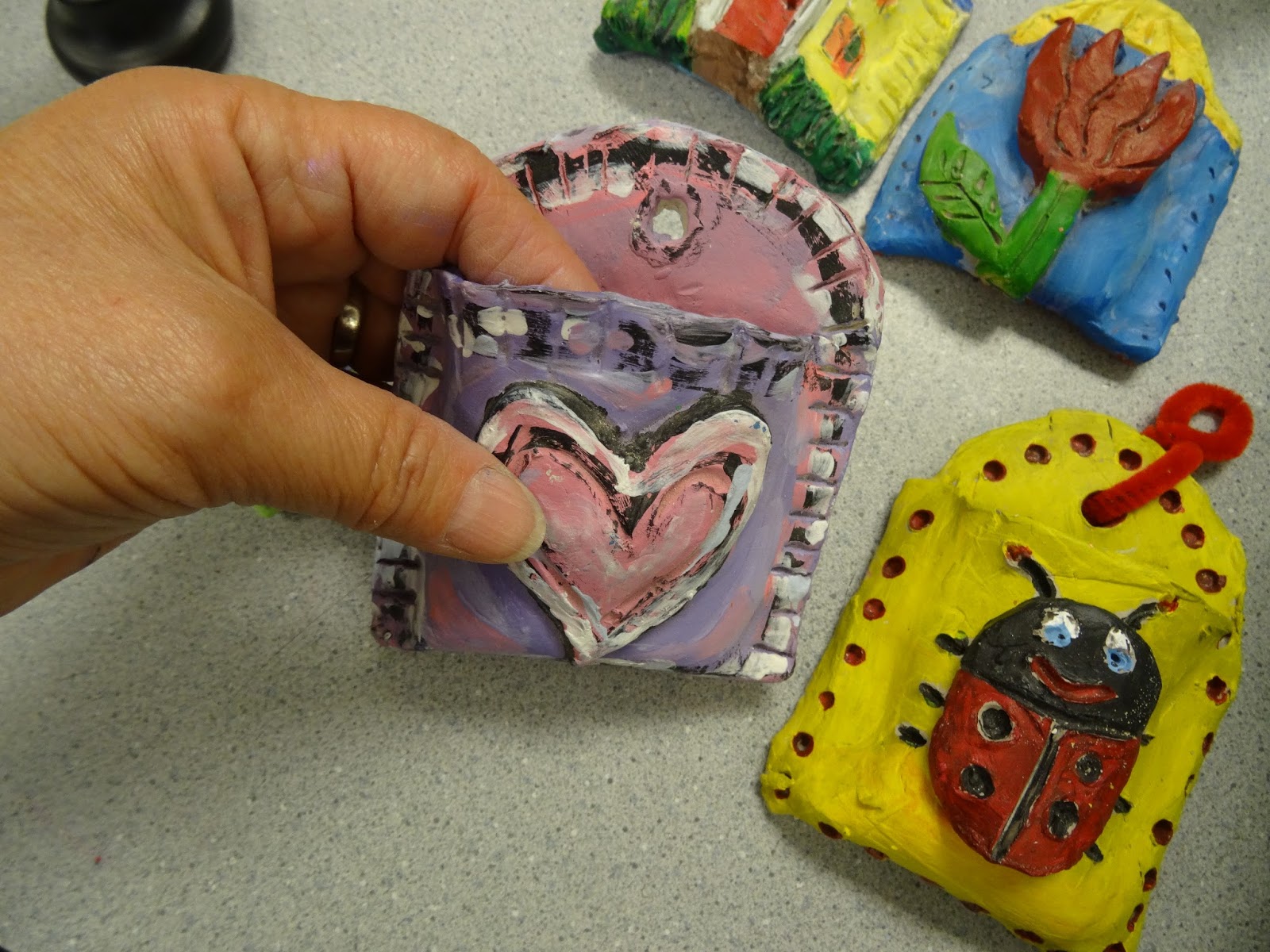
In order to get a clay project complete in one art class, a good idea is to use the prior art class for "clay play", to familiarize the students with the materials and the techniques, and also to demonstrate what they will be doing in their next art class.  That way, in the next class, all you need is a quick review and away you go!  I always had blocks of clay measured out and ready for the kids, so they could get right to work.  The "posy pockets" pictured below are an example of an air dry project that was successful.  I often did this with my 2nd graders.
To make these, students rolled out a rectangular slab, trimming off any excess.  They scored close to the long edges, put slip on the scored edges, and then folded the pocket, leaving about a third or quarter of the rectangle above the fold, and keeping a couple of fingers inside when they folded. Then, the top was trimmed to an arc or peaked shape, and any remaining clay after trimming was used to make embellishments, which were attached by scoring and putting on slip.  I had the kids put two fingers in the pocket and gently wiggle the decoration into place, as though they were playing with a peanut butter and jelly sandwich and wanted to get the jelly to squirt out the sides.  This way, the embellishment would stick better.  We also used tools to add texture, and cut a hole in the top for hanging over a nail. 
The posy pockets (and pretty much all air dry clay projects) were painted with acrylic paints; I used Nasco's Bulk-krylic.  The kids were cautioned NOT to use air dry clay for food or liquids; it is not permant.  So we made tiny tissue paper bouquets of posies, with pipe cleaner stems, to put in the pockets.
The fish above are a slab project similar to the posy pockets but requiring a bit more sophistication.  Instead of putting our fingers inside, we stuffed the mouths with paper towels.  Again, excess clay was used for embellishment.

The fish below were a ridiculously easy slab project.  Again, a slab was rolled out.  I demonstrated how to cut the slab to make tail and fins and mouth, and again extra clay could be used for embellishment.  The fish body was curved to stand up. 
We made clay people using a similar process, starting with a rectangle, cutting away squares from the both sides of the top to leave a head, and vertical rectangles from both sides of the bottom.  Then slits were made straight up from the corner of where the rectangle was cut, to create arms, and a slit was cut in the bottom to create legs.  The bodies could then be molded and posed by bending and pinching the clay.  We used this process because air-dry clay is much more breakable, and if slip and score techniques are not used well, add-ons will fall off.  So working with a one piece pull and pinch construction with younger kids was very successful. 
We made a lot of crawly critters this way - lizards and dragons and alligators and turtles and such, as well as animals lying down, like cats and dogs.  This way, we avoided the narrow appendages snapping off.  Still, sometimes they will break.  Glue generally does NOT hold air dry clay.  The best solution I have every found is using the acrylic paint to repair breakage.  So, when the tail of the critter below broke off, I fixed it by filling the gap with green acrylic paint.  In worst case scenarios, we'd joke about the art room being a hospital for injured animals, and "Dr. Brown" (me) would fix them, and add a little band-aid for extra security!
My fourth graders usually made coil pots, using the Mexican Pottery Clay.  Their work was much larger than my quickie samples below.  We used scoring and slip and the peanut butter and jelly wiggle again!  Snails could be made and worked into the pot as desired, by placing a coil up and over them to secure them.  I had the kids frequently hold them up to the light to check for gaps, and then wiggle the gaps closed.  I gave each child a hunk of clay to start, they rolled the base, and then started adding coils.  If they ran out of clay, they could come for another hunk until we ran out of time.  Some students made small pieces with fine coils, others made big wide or tall pots.  My samples are small because all I did was a quick demo of coil technique. 
Again, we painted with acrylic, and used it to fill any gaps.  Acrylic paint makes the piece stronger. By the way, the kids could choose to leave the clay color exposed, but then would use an acrylic gloss such as Mod Podge to paint over it.  For tall narrow pots, we poured in the gloss or paint, tilted it around to cover the inside, and then drained out the excess paint. 
 And of course, we made pinch pots.  (But no, I never made a single pinch pot owl.  Sorry...)  These "pinch pot clusters" pictured below were a favorite of my first graders, to take home and store their tiny treasures.  They made three little pinch pots, scored and used slip to hook them together, and smoothed over the joints. 
 And we sometimes made cave paintings on random shaped clay slabs.
 Finally, a quickie easy project, that was always a lot of fun.  Sneaker imprint jewelry!  The kids loved pushing clay gently into the bottom of a neighbor's shoe, and then cutting them in interesting shapes.  After these were dry and painted, we strung them with yarn and beads and more. 

Late edits to this post - four points to make:

First - There is NO REASON to wedge air dry clay, since you won't be firing it and don't have to worry about it bursting.   Actually, it is counterproductive, as it dries it out.  

And second, try to finish everything in ONE SESSION.  Keeping air dry clay properly moist and to a workable consistency once it's been out in the air is very difficult.  Just get it done, and move on... You'll have trouble trying to continue working successfully on an air-dry piece after one sitting.  

And the tools - you can use inexpensive plastic modeling tools, for scoring and texturing, as well as little pointed wooden sticks, and also, of course, slip made from the clay.

And finally, getting them home safely - I would ask students to bring in cube-style tissue boxes, which were great for bringing home coil pots, for example.  We padded them in newspaper or other stuffing material before gently putting in the box for safe travels.  I always warned kids against putting clay projects in the bottom of their backpacks, where they'd throw lunchboxes and sneakers on top.  For the little pinch pots and other small delicate pieces, if I had nothing to pack them in safely, I told the kids to carry them in their hands like they were baby birds, who hadn't yet leaned to fly.  If they fell out of the 'nest', they probably would be injured.  I loved seeing them walk to the school buses, cradling their 'baby birds' in their hands!

Monday, June 6, 2016

Lovely Lilacs Revisited

I subbed in my former classroom for a day recently, so that the current teacher could deal with a medical concern.  I had fresh lilacs growing in my yard, which, when I was still teaching, I brought in every year for a one-day lesson for my younger students, usually the first grade.  I told the teacher I'd love to paint the lilacs with her students, with her permission.  The 2nd grade students had just finished a project, so rather than have me start her next project for her, she gave me the go-ahead to do these paintings.
So I brought in a batch of the lilacs and put them in vases.  The kids looked at and smelled the flowers, examined how they grew in bunches, and how the leaves came to a point.  We looked at several different vases in the room, with various shapes, and discussed how even though each one was different from the next, the shapes were all symmetrical.  Some were opaque, and some were transparent, and we looked at that, too.  Then we talked about how we didn't want vases of flowers floating in the air, so we wanted to place them on a table in our drawings. 
The kids drew a vase, stems, leaves, and table, using crayons on construction paper (I gave them a selection of colors of paper to choose from: lilac, pale blue, soft green, pale peach, and soft yellow.  Looking at these photos, I realize that if anyone chose the yellow, somehow I didn't photograph it!)
Before the kids came in, I mixed up some tempera paints in disposable cups with various lilac colors, some with more pink, some with more blue, some lighter, and some darker.  I discussed with the kids how there are many different varieties of lilacs, with colors from white to purple to pink to blue, and that they could use any of the paint on their tables for their flowers.
I gave the kids long-handled cotton swabs to paint their flowers.  We noted that the tip spread out as is was used, making it easier to paint the flowers than with the small tip we began with! 
We had just 40 minutes, including the time I needed, as a sub, to review the class list of names, and time to clean up.  (Clean up was pretty easy, since the swabs were simply thrown away, and at the end of the day I also threw away the disposable paper paint dishes.  We put the paintings in the drying rack and did a quick table cleanup and we were done!)
As a veteran art teacher, I didn't generally like to repeat all the exact same projects every year.  But there were some lessons that, with some simple variations, were an annual ritual.  The lilacs were one of these.  There were staff members that looked forward to seeing them hanging in the hall every year, and since they were quick and easy, and made everyone happy, I loved to oblige by repeating this project.  They look so fresh and spring-like, and sometimes I think I can smell the lilacs when I look at at them!  Thank you to the current art teacher for allowing me and the students to have this fun break from her curriculum!