Showing posts with label templates. Show all posts

Saturday, November 10, 2018

New Project: People in Motion

I love inventing new projects.  My DragonWing Art students (2 girls and one boy) just completed a couple of these first-time projects, one of which I'm sharing with you today!
The theme for our 7-week session was 'Let's Get Moving'.  For the project I'm sharing today, the theme was 'people in motion'.  Each student created their own movable template for a person, cutting out out body parts and assembling them all with brass fasteners so that the limbs could be arranged in various poses.  I thought about showing the students Duchamp's Nude Descending a Staircase, but not knowing two of the children or their parents very well, I decided against it. The kids did a great job, nevertheless.
Once assembled, the templates were traced repeatedly performing a moving action, such as the bowling image below.  The outlines were traced over with a black Sharpie.

Then, class was postponed for a week because of an unexpected visitor in our classroom. I'm terrified of rodents, and was freaked out to see a squirrel standing on the table next to the drying rack.  Pest control was called, and after a few days the invader was trapped and released hopefully very far away. With my husband's help, the gap at the bottom of the classroom door was covered with metal stripping, and the building was better secured.  Nothing had been destroyed in the room but with the squirrel trapped in there, he'd made a big mess, with stuff knocked over on the floor and squirrel droppings here and there.  The custodian did a first cleanup but was afraid to move the art stuff.  So then I took everything out of the room and did a thorough cleaning, and put  it all back, getting rid of some useless stuff in the process.  Then the custodian did a final cleaning/disinfecting.  Hopefully no more rodents, ever!

Anyhow, once the classroom was ours again, and the templates were traced, the students had a choice of three ways to add color.  One way was to trace inside the outlines of the figures with markers, and then use wet paintbrushes to pull the color into the figures and let the colors blend, as being done by the boy below.
The girls used the same method to color their figures.

 For their backgrounds, the girls used a second process.  They colored with pastel chalks, and then dipped a finger into liquid starch and used the wet finger to blend  the chalk colors.  The starch helps to blend, and also to 'fix' the chalk.
 One of the girls had missed a class and never outlined her figures with Sharpie.  I think it added an ethereal look to her diver in front of a beautiful sunset (or is it a sunrise?).

Instead of using the chalk and starch, the boy chose to paint his background with tempera paints.
I only had three students in the fall session of my class; one 4th grade girl, and one 5th grade girl,,and a 3rd grade boy.  The two younger kids were first-timers in the class, and none of them had ever met each other before.  After a rather quiet first class, they suddenly all became a wonderful unit, treating each other so nicely, laughing and relaxing and complimenting each other on their work.  By the end of the session, the two girls had exchanged phone numbers to arrange play-dates.  I couldn't have had a nicer little group.

One more time, here's the transformation of the piece at the top of this post, from before and after the chalk color had been added. Pretty cool, isn't it?
Look for another one of the new projects (hint: its based on the 'Let's Get Moving' theme, and was created with papier-mache) in a blog post coming soon! 

Wednesday, April 4, 2018

A Tale of Two Workshops: Tooling Foil and Bead Weaving

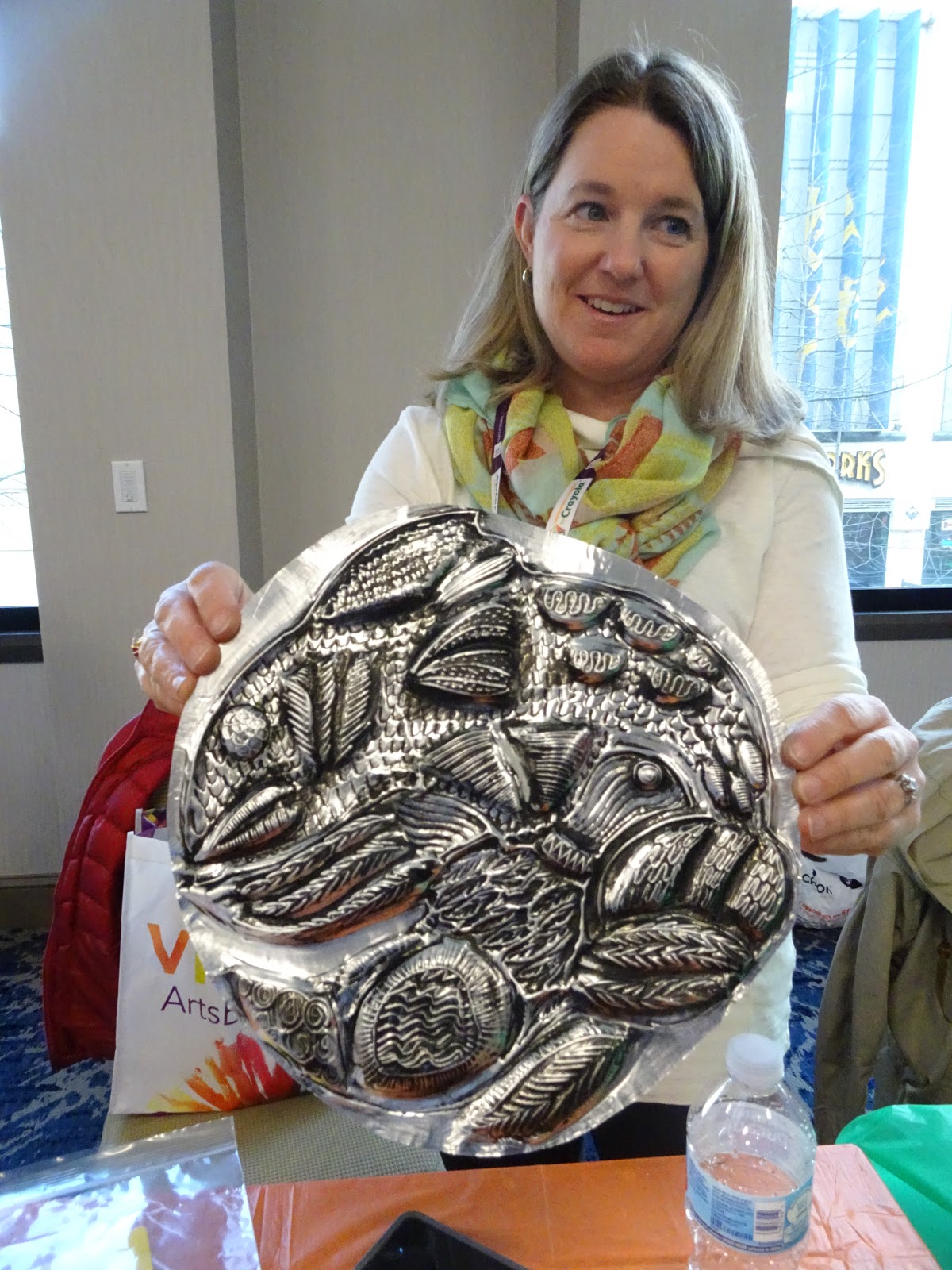
I had the pleasure of teaching 2 studio workshops at the recent NAEA convention.  The first was called Wampum-Inspired Bead Weaving for Modern Times, and the second was Oh What a Relief - Fabulous Tooling Foil! The pic above is a piece made by a participant during the tooling foil workshop.  Nice, huh?  This is me, below, by the way.   I probably should update my profile pic on this blog one of these days.... 
Anyhow, for the most part, I think both workshops were pretty successful.  I'm not going to go into full "how-to" details about the projects here, because I will direct you to them elsewhere on the blog, in previous posts and such, because both are projects I've posted about several times.  Instead, I want to tell you about some stuff that happened in each workshop, one good, one not-so-good.
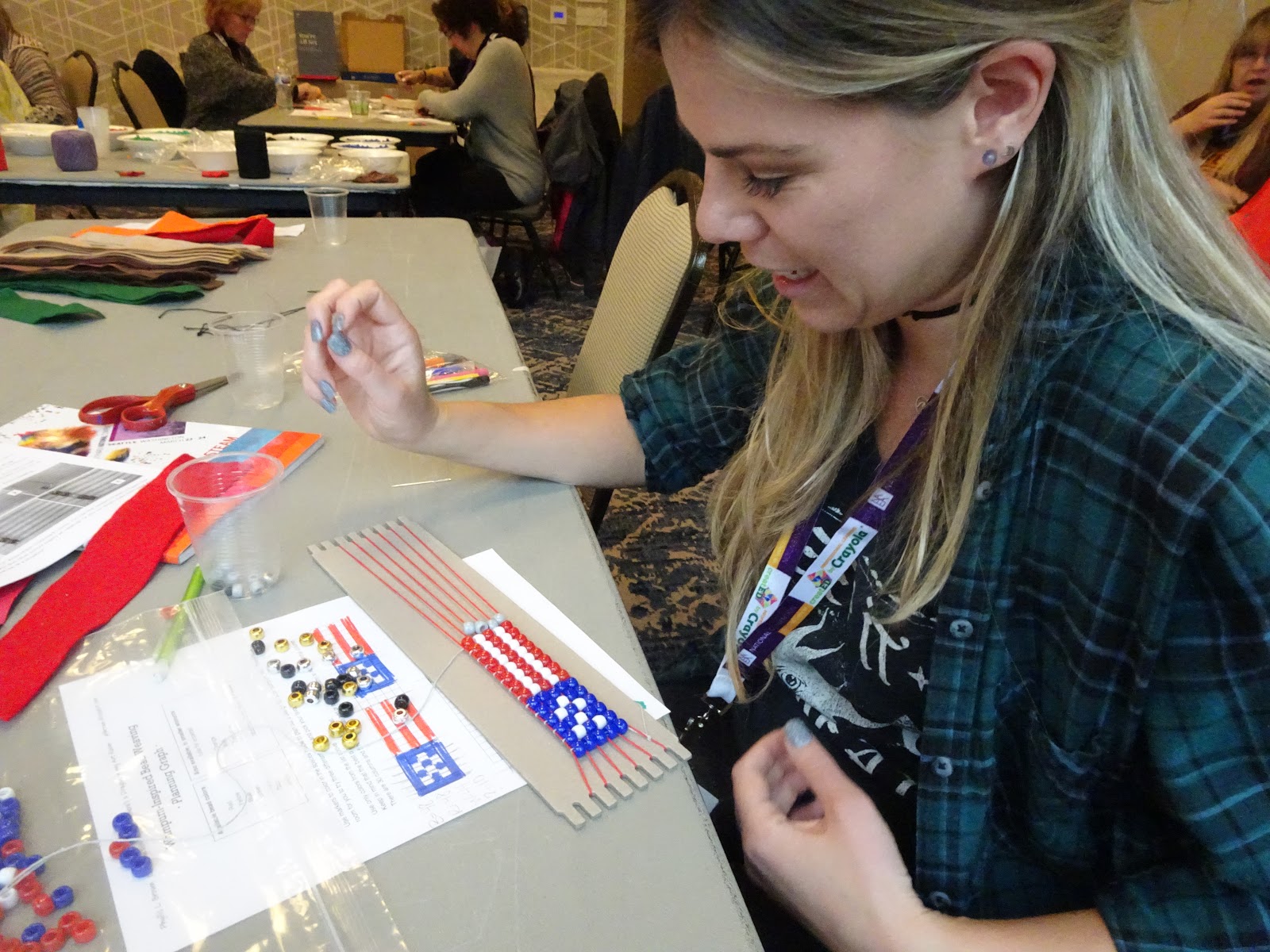
In the bead weaving workshop, I spoke briefly about the need to be sensitive about cultural appropriation.  I made the point that these are not "wampum belts", but instead are a modern bead weaving INSPIRED by the wampum bead weaving of the Eastern Woodland tribes of Native Americans.

A woman in the class spoke up and said she and her companion (both pictured below) were Eskimos, attending the convention from Alaska.  Pictured on the left, Stacey told me she lives in Shaktoolik and grew up in Shishmaref, and is a member of the Inupiaq tribe. (I just looked up both of these locations on my map app, and wow, these are remote locations!)  She asked if she could use her family design (I hope I'm using the correct terminology here) for her weaving design, and I thought it was a great idea.  You can see, above, her graph planning it out, and her completed project. She used a red string for her weaving, which she said denotes strength.   The woman pictured on the right is DeAnn, and is the Alaska Art Teacher of the Year! The pattern in her weaving is not symbolic.  I was tickled to meet them both, and loved their enthusiasm.  I wish I'd had more time to chat, because Stacey was showing me pics (on her laptop), but unfortunately there were 18 other participants to attend to, and the 1 hour and 50 minutes just flew by!  Later in this post, you'll see some other pics of participants in this workshop, and their creations.
You can find my handout with instructions at THIS LINK.  The planning graph for making these weavings can be found HERE.  Please be respectful about giving credit as appropriate when using my materials.

 As a presenter, I was initially more confident about the tooling foil workshop, because I'd twice previously taught this at my state convention here in NY.  But still, it is, however, a challenging project to learn about and bring to completion in less than two hours.  But many participants did, and were successful.  I love seeing smiles!
For the workshop handout, go to THIS LINK.   For videos on the process, you'll find them in the post LINKED HERE.  Again, please be respectful about my ownership of these documents and videos. 
I had many examples, and offered many suggestions, based on what works best in the material.  So I was not surprised to see the robot (above), and the masks (below), because they are themes well-suited to the medium.  I'd love to see how the unfinished ones turn out!
This piece pictured below really intrigues me, as a study in texture and repetitive pattern. I think when complete, it will be gorgeous. The black ink that is added to 'antique' the piece will really highlight the detail of all the unique textures.  Really lovely!
But I had one thing happen during the workshop that caught me off-guard.  As I said, I offered many ideas, both in visual samples I that I brought, and in images and text included in the handout.  But three people in the workshop, rather than using my ideas and suggestions as a resource to inspire them, instead chose to trace one of my pieces while I was helping people elsewhere in the room.  Nobody asked permission; if they had, I would have responded that they did NOT have permission to trace my work, but were welcome to use the theme of the piece and create their own versions.  If you're a long-time reader of this blog, you probably know that I'm generally opposed to the use of templates and tracers, except for simple geometric shapes (circles...).  So I was certainly surprised to see my own original creations used as templates. In the interest of keeping the atmosphere of the workshop positive, I let it go and didn't say anything at the time.  But I'm sharing it here, to remind you all that copying without permission is NOT OK. 

Here's my friend Emily with me, showing her work in progress in the bead weaving workshop, and also a couple of my samples.
And some more pics from the workshop!
I love how wonderfully colorful this woman below is!
Lots of smiles!
If you want to see student examples from both the bead weaving and tooling foil projects, there's lots and lots on the blog.  Make sure you are viewing the web view of the blog (using your browser - Safari or whatever).  Then you'll be able to see a cloud of 'labels' (tags) at the bottom of the page.  You can search the cloud for words like "tooling foil" or "wampum weaving" and it will bring you to a bunch of older posts on the topic. Another alternative, also on the web view, is to use the "Search this blog" tool on the right side of the blog.  Type in whatever you'd like, and it will help you find it!
 Please let me know if you have any questions on either workshop/process that aren't answered in my handouts or in prior blog posts.  Thanks for visiting, and remember to be respectful of the work of others! 

Wednesday, August 11, 2010

What's on my mind...


This post is not about a waterlily or a turtle on a log. I just wanted to have an image at the top of the blog so I used pics I shot while kayaking in the marsh a couple of days ago.

I've been planning on writing this post since last spring, but instead of putting down the words I've been thinking, I've posted just about everything else this summer -sewing a new art shirt, African animals, blueberry pies...

But today I went to my sparkly shiny classroom to start unpacking colorful art supplies, in anticipation of the opening of school in a few short weeks. And on Friday I'll be reading applications from candidates for the sudden job opening for secondary art teacher in our district, and thinking about what is important to find out when we interview the candidates next week. And I got to thinking I need to say here what has been on my mind. I hope I don't offend any of you; certainly no offense is meant. I just want to get us all thinking about our jobs and what it is that we do and should be doing, so that we can all be the best we can be and encourage our kids to be their personal best as well.

I'm not one for all sorts of professional/philosophical mumbo-jumbo or fancy terminology, so I'm going to be pretty simple here about what I want to say.

I've been regularly reading lots of blogs, and I think as a whole, art teacher bloggers are a pretty amazing bunch. Every day I see something that makes me say "I want to try that!". But I also see things that make me think about what we as art teachers should and shouldn't be doing. I have to step back and remind myself that we all bring very different educational training, experience, and backgrounds to our jobs, as well as we are working in schools and states and even countries that have completely different requirements for art instruction. So maybe I'm too judgemental. Anyhow, after a bunch of avoidance, here comes the real text of this post, which I should call "Templates, and Tracers and Mess, Oh My!"

Here's something that I've noticed - lots of bloggers seem to promote using templates and tracers to make artwork look 'better'. My concern is that this is not teaching kids how to think independently, and instead the template becomes a crutch. When you want them to do it on their own, they say "I can't" and instead want something someone else has drawn to use, to copy, to trace.

I say we should be giving the kids the tools and the confidence to do it on their own. Give them examples to look at, break it down into a way that they can be successful without everyone's artwork looking the same. Give kids lots of opportunities to draw from observation. Have them take turns being models, set up an interesting still life, practice contour line drawings of hands and shoes using felt pens so there's no erasing, etc. Draw with sticks or bamboo dipped into India ink and let mistakes become a part of the drawing. The kids are always pleasantly surprised at what they can do without copying or tracing.


Another thing I've noticed on the blogs are those folks who express fear over doing some lessons/projecs because they are messy or 3-D. In this technology-heavy world, my top priority is giving kids regular hands-on experience with a variety of art materials, both 2 and 3-D. I want them dipping their hands into gooey papier-mache, loading up brushes with thick creamy paint, drawing with a chalk pastel on wet paper and watching it turn into paint, gluing together hunks of cardboard, weaving with fibers, covering their hands with charcoal, and so much more. I want the kids exploring their imaginations and generally stretching their creative muscles, learning to think and figure things out on their own. I want them to be independent thinkers and take ownership of the work they do in art. I want to teach them how to clean up so that everyone wants to take part in cleaning. I can't imagine choosing to teach art if I was afraid of dealing with the mess.

None of this means that I'm one of those teachers that puts out a bunch of materials and says "have fun". That's not teaching. I strive to give the kids the information and tools they need to be confident independent thinkers and problem solvers.

We do learn about artists and multiculturalism. I have an "artist of the month" bulletin board in my room, where I showcase a variety of different artists each year. The photos above are (obviously) from a lesson on Jackson Pollock. The 4th graders loved making these paintings, but we struck a deal ahead of time regarding cleanup. About 1/2 the class time was set aside for cleaning! And the kids were happy to do it and worked enthusiastically and respectfully. The paintings were a real hit when I displayed them in the hallway.

I'm afraid I've gone on longer than I intended, and I'm not really sure I've made my point. I do know that certification requirements, professional development requirements, and standards vary from state to state, and maybe this colors my perspective on what art ed should be.

Anyhow, please weigh in with your opinions, and don't be afraid to tell me I'm all wet. I won't be offended! And if I've made you think, that's always a good thing, right? Maybe some of your insights will help me when I head into the art teacher interviews next week. Can't wait to see what the candidates bring and who my new colleague/teammate will be!

Thanks for listening!